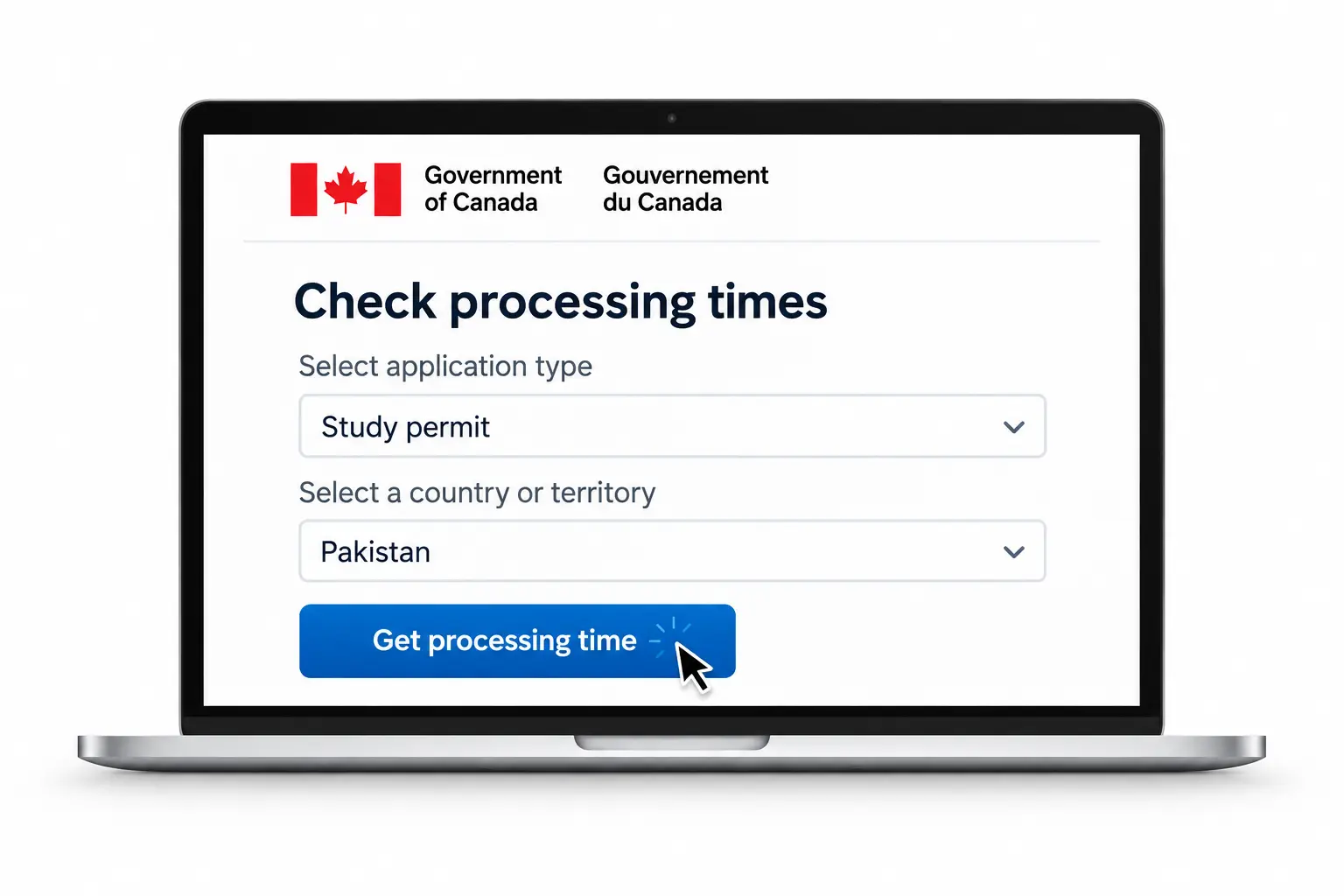
How long the study permit wait really is from Pakistan in 2026, what changed after the SDS ended, and exactly how to check your own estimate on the official IRCC tool.
If you are planning to study in Canada, the first question on your mind is usually about the Canada student visa processing time — how long the wait really is from Pakistan, and what you can do to avoid delays. The honest answer for 2026 is that there is no single fixed number. Processing depends on your visa office, the completeness of your file, and the time of year you apply. Most Pakistani applicants going through the regular study permit stream should plan for roughly 7 to 16 weeks of official processing, and a longer end-to-end timeline once you include preparing documents, biometrics, and a possible medical exam.
This guide gives you the accurate, Pakistan-specific picture. We explain how Immigration, Refugees and Citizenship Canada (IRCC) calculates the Canada study visa processing time, what changed after the Student Direct Stream ended in 2024, the realistic stage-by-stage timeline after you apply, and exactly how to check your own estimate on the official IRCC tool — all based on current government guidance.
For most Pakistani students applying in 2026, the Canada student visa processing time through the regular study permit stream falls in the range of about 7 to 16 weeks from the date IRCC receives a complete application. There is no longer a guaranteed fast-track option for Pakistan.
That figure is only the official processing window. Your real, end-to-end timeline — from accepting your offer to holding a stamped passport — is usually longer, because preparing your Provincial Attestation Letter, proof of funds, biometrics, and medical exam all add time before and after the IRCC clock runs.
The single most reliable number is the live estimate IRCC shows for Pakistan on its official processing-times tool, which is updated weekly. Always confirm the current figure there before you finalise your plans.
IRCC publishes processing times for study permits by country of residence and refreshes them weekly. The number you see represents the time it took to finalise 80% of recent applications — not a deadline or a promise.
| Route (2026) | Who it applies to | Indicative IRCC window |
|---|---|---|
| Regular study permit stream | All Pakistani applicants | ~7–16 weeks (check live IRCC tool) |
| Student Direct Stream (SDS) | No longer available — ended Nov 2024 | Not applicable |
Pakistan sits among the higher-volume visa offices, alongside India and Nigeria, so waits often land in the middle-to-upper part of that range. Some applicants are decided faster; others wait longer when background checks or document requests are involved. Treat any single number as an estimate, not a guarantee.
Application volume spikes from May through August, when students rush to meet September intakes. Files submitted in this peak window can take an additional two to four weeks compared with off-peak months. Applying for a winter (January) or summer intake, or simply submitting early, often means a shorter wait.
Understanding IRCC's method explains why your wait may differ from the posted estimate.
The processing clock begins only when IRCC receives a complete application — all required forms, fees, and supporting documents. If anything is missing, your file may sit in a queue before the official timer even starts.
The clock stops when a final decision is made. If an officer asks for additional documents, requests an interview, or flags your file for further security or background screening, that waiting time is generally added on top of the standard estimate. This is the main reason real timelines often exceed the published Canada study visa processing time.
The Student Direct Stream (SDS) is no longer available for Pakistan, or for any country. IRCC ended the SDS and the Nigeria Student Express on 8 November 2024 at 2:00 p.m. ET. Applications submitted on or after that time are processed through the regular study permit stream.
The SDS, launched in 2018, once offered roughly 20-day processing for eligible students from 14 countries, including Pakistan, in exchange for upfront proof of a Guaranteed Investment Certificate (GIC) and approved language scores. Canada closed it to give all international students one consistent, fairer application process and to strengthen program integrity.
The financial expectation has also risen. Under the cost-of-living rules introduced in 2025, a single applicant outside Quebec must show roughly CAD $22,895 for living expenses, plus first-year tuition and travel costs, regardless of stream.
Here is what actually happens once you submit, and roughly how long each stage takes for a Pakistani applicant.
Within about 1 to 5 business days of submitting online, IRCC confirms it has received your application.
Shortly after, you receive a Biometrics Instruction Letter giving you 30 days to provide fingerprints and a photo at a designated centre in Pakistan.
If required, you complete an upfront or requested medical exam with an IRCC-approved panel physician.
IRCC verifies your documents, finances, and admissibility. This stage is the most common source of variation in the Canada student visa processing time.
IRCC approves or refuses the application.
If approved, you are asked to submit your passport for the visa to be stamped, then it is returned to you.
Completing biometrics quickly and responding to any document request without delay keeps your file moving through these stages efficiently.
Several variables decide whether your wait lands at the short or long end of the range.
A missing form, an unsigned page, or an absent Provincial Attestation Letter (PAL) can stall your file before processing even begins.
Officers review funds carefully. Clear, traceable bank statements and a properly sourced GIC reduce the chance of a follow-up request that adds weeks.
Some files are selected for deeper checks. This is routine and unpredictable, and the extra time is added to your estimate.
Submitting between May and August, when volumes are highest, generally lengthens your wait.
Country-specific demand directly shapes the posted estimate, which is why Pakistan's figure can differ from other countries week to week.
Planning your budget too? Review current Canada embassy fees alongside your timeline.
The most accurate estimate for your situation comes straight from IRCC. The tool is free and updated weekly.
Use this number as your planning baseline, and re-check it close to your submission date, since it can shift from week to week. After you apply, you can also track your file's status through your IRCC online account.
Two practical steps in Pakistan can quietly add weeks if you are not prepared for them.
After you receive your Biometrics Instruction Letter, you have 30 days to attend a designated collection centre. These centres operate in specific cities, so confirm which location serves your area rather than assuming the nearest office handles study permit biometrics. During peak season, appointment slots fill up, so book as soon as you receive the letter.
If your application requires a medical, you must use an IRCC-approved panel physician. Booking and receiving results can take a couple of weeks, so completing an upfront medical exam — before or at the time of submission — can prevent a later request that pauses your file.
For step-by-step help with this stage, see our guide to the Canada biometric appointment in Pakistan.
You cannot pay to jump the queue, but a clean, complete file is the most effective way to keep your Canada study visa processing time as short as possible.
Submit at least 16 weeks before your program start date. Given Pakistan's volumes, aiming for closer to 24 weeks gives you a comfortable buffer.
Use IRCC's document checklist for the regular stream and double-check every upload before you submit. Errors at submission cost weeks.
A clear, genuine SOP that explains your study plan and ties to your career goals reduces the risk of an officer raising questions.
Show the required living-cost amount plus tuition and travel, with consistent, well-documented bank statements and, where used, a properly issued GIC.
If IRCC asks for more information, reply within the deadline to keep the clock running rather than stalled.
Map your dates and budget with our timeline and cost calculator.
The Canada student visa processing time from Pakistan in 2026 is best understood as a realistic range — about 7 to 16 weeks of regular-stream processing — rather than a single guaranteed number, with your true timeline shaped by document quality, biometrics, screening, and the season you apply in. With the Student Direct Stream gone, every applicant follows the same regular study permit path, so a complete, well-prepared file is now the only real way to keep your wait short.
Plan early, build your checklist around current IRCC requirements, confirm the live estimate for Pakistan before you submit, and respond promptly to any request. If you would like hands-on support preparing your study permit file, the team at EasyVisa can guide you through each step. You can also explore your wider Pakistan student visa options.
A complete, accurate application is the fastest path. Let EasyVisa.pk guide your Canada study permit step by step.